| Muses Review Online Author Interviews Fall 2006 - Oct Nov Dec |
| Featured Writer for Fall 2006 Kirby Wright: A Hawaiian Novelist Interview Conducted by Andrew Angus |
| Note: The interview is cut short because the full interview will be published in the print edition of Muses Review. |
| Muses Review Fall 2006 Oct Nov Dec Table of Contents Editors Message Editor's Poem Poems Poem Reviews Book Reviews Interviews Book Ads |
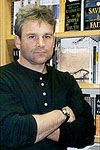
| Kirby Wright Writer/Poet from California |
| Buy My Book : Punahou Blues |
 |
 |
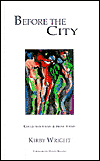
| Kirby Wright's books: >2003: Before the City: Collected Poems and Prose Poems >2004: Punahou Blues |
 |
|
| INTERVIEW WITH KIRBY WRIGHT, Writer, California, USA Legend: Bold Letters: Muses Review, Non-bold Letters: Kirby Wright I. Your opinion 1. Tell the readers, what is your fiction book Punahou Blues all about? This is a flashback to the tumultuous 60s and 70s in Hawaii. It's a coming of age novel written from the perspective of an outsider attending a Honolulu high school. The narrator's rite of passage includes losing the girl of his dreams, surviving Killahaole Day, coping with his father's great expectations, fighting the school bully, and dealing with the tricky matter of interracial dating. 2. What motivated you to write? The death of my grandmother and Kurt Vonnegut, Jr. writing the following in my copy of BREAKFAST OF CHAMPIONS: "To Kirby Wright, who will make it as a writer. I know these things." 3. Did you apply for a literary grant to finish your fiction book? Yes If yes, what organization gave you the grant? Arts Council Silicon Valley 4. Tell us something briefly about yourself. I was born and raised in Honolulu, Hawaii and spent summers with my grandmother on the island of Moloka'i. I'm a graduate of Punahou School in Honolulu and the University of California at San Diego. I received my MFA in Creative Writing from San Francisco State University, where I studied under the tutelage of Frances Mayes. 5. Name your three favorite chapters in your fiction book? Why? I like "Punahou Carnival" because it creates a triangle between Jeff and his two love interests. Lucy is a girl-next-door type who's available and willing. Debbie is the unattainable fox. The carnival brings them all together and creates an emotionally charged situation. I also like "The Ring" because it raises the question of whether the dead/spirits can affect our lives. "The Fight of the Century" was fun to write because the underdog stands up to the school bully. 6. Why should people read your fiction book? PUNAHOU BLUES is the story of an underdog. It's a believable rite of passage that touches on the complexities of multicultural Hawaii, prejudices against (and within) Punahou High School, and the tricky matter of interracial dating. 7. How many years did it take for you to finish your fiction book? I wrote it off and on for 5 years. 8. Who chose the design for your book cover Punahou Blues? A friend recommended a Maui artist named Holly Lewis. Holly came up with the cover design after reading the chapter "Punahou Carnival". 9. Do you have a pen name when you write fiction? No 10. What were your jobs before you decided to become a writer? Coral raker, general laborer on a ranch, construction worker, painter, auto salesman, proctor, timeshare supervisor, pr director for a resort, teacher, editor, development director for a non-profit. 11. How many years did you stay in Hawaii? 25 12. Where can people buy your fiction book ? Borders, Amazon, Barnes & Noble 13. Do you like to travel? Yes. I've visited Mexico and Canada. 14. How many years have you been staying in California? 20 15. Nowadays, people want to be called a writer. What is so good about being a writer? You get to document your life and your feelings. 16. As a writer, how can you reduce the tension between white and colored people in Hawaii or in mainland USA? By exploring the interior world of a character of mixed blood. 17. Have you tried writing for TV or stage? Yes. I've had two plays produced. "Houdini" was performed at the 1999 Actors Alliance Festival in San Diego. "Birdbrains" opened in Hollywood last April. 18. What event/s triggered you to go into writing? The death of my grandmother on the island of Moloka'i. I knew I was the only writer in the family and , if I didn't write about her, nobody would. 19. Do you sometimes dream of having your literary works tapped for movies or TV? Yes. But I'm not holding my breath. 20. What are your plans in five years time as a writer? To write the Great Hawaiian Novel. 21. Do you have a literary agent? Yes 22. Have you experienced making book-signing tours? Yes. I have several scheduled for June (Editor's adition: 2006) in Southern California. 23. Who is your favorite character in your novel? Why? I like Jeff Gill because he is an underdog who must overcome numerous obstacles in his quest for identity and his search for love. 24. Are you a haole or a hapa-haole? I am hapa haole because I have Hawaiian blood. My great great grandmother was pure Hawaiian from Maui. 25. Do you also write short stories? Yes 26. Have you won significant or minor writing awards? If yes, can you name some of them? Two Pushcart Prize nominations and winner of the Ann Fields Poetry Prize, the Academy of American Poets Award, and the Browning Society Award for Dramatic Monologue. I have also received four San Diego Book Awards, two Arts Council Silicon Valley Fellowships, and three first place cash prizes in the Alsop Review Short Story Contest. I am a subject of biographical record in the forthcoming edition of WHO'S WHO IN THE WORLD. 27. Is your book, pure fiction or pure true story or a mixture of facts and fiction? It's a mix. I think most first novels are autobiographical to some extent. 28. What company published your fiction book? Lemon Shark Press 29. Do you know any novelist born in Hawaii aside from yourself? Yes. Kiana Davenport. 30. Have you experienced teaching (creative writing, literature) in college or high school? Yes. I taught Creative Writing at Palo Alto Adult School and English Comp at the Art Institute of California. Part II. Your Background 1. Were you interviewed in a literary magazine or newspaper before? Yes If Yes, can you name the literary magazine which interviewed you? Megaera If Yes, when or what year? 2005 |