| Muses Review Writer Interviews Winter 2006 - Jan Feb Mar |
| Featured Writer for January 2006 Edward Einhorn: Modern Theater of the Absurd Interview Conducted by Andrew Angus |
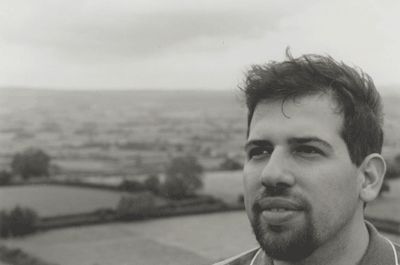
| Edward Einhorn Writer from New York |
| Muses Review Winter 2006 (Jan Feb Mar) Table of Contents Editor's Message Editor's Poem Poems Poem Reviews Book Reviews Interviews Book Ads |
| From: Utc61@aol.com Date: Fri, 9 Dec 2005 02:13:09 EST Subject: Re: Interview for Playwright Edward Einhorn To: admin@musesreview.org I hope this is helpful. Edward Einhorn AA: stands for Andrew Angus, EE stands for Edward Einhorn. Part I: About Your Book 1. AA: What motivated you to write plays? EE: I have always been a particular fan of theater. My brother used to read me plays as well as children's books when I was young, particularly plays in the theater of the absurd genre. My parents thought he was insane to read me such sophisticated material, but I loved it, even when I didn't fully understand it. I knew I wanted to be a writer very early, and when I was in college I gravitated towards the theater group. I started by directing and acting, and the natural result was that the focus of my writing became theater. 2. AA: Why do you like to compose plays? EE: I love their economy. I love that they tell a full story in so many words fewer than a novel and that every word counts. And I love that plays are a collaborative medium, so they can become anything when combined with a different director who brings different actors and designers. Well, I usually love that. It's scary to realize that almost any play can seem bad when combined with the wrong elements. 3. AA: Can people make a living out of writing plays? EE: So I've heard. I've never actually seen it, but it's been whispered. Actually, you can, but you need to be one of a very few. And even the most successful playwrights often supplement their income by teaching. 4. AA: What makes a playbook a bestseller? EE: Books of plays don't become bestsellers the way novels do. There's just not the same sort of audience interested in reading them, unless they are a classic and read in schools. But they do allow the play to be out there in the public, which encourages more productions. 5. AA: What are your favorite themes in composing plays? EE: I have noticed that a lot of my plays deal with identity. It wasn't a conscious choice, but there is often a character like my version of the Golem, who is possessed by the spirit of someone else and it seems unclear who he is. Also, I write a lot about memory, or faulty memory to be exact, about how old stories form our views of the world, about Judaism, and about everyone's favorites, love and death. 6. AA: Why should people read a playbook? EE: I find that reading a book of plays is a joy in itself to me, separate from watching them. Perhaps it is because they engage my imagination so much. A play in written form is so open and so suggestive, so it can be anything. It is like the old days, when people had radio instead of television. Television is easier, but in some ways radio is more rewarding, because it lets you create your own pictures. 7. AA: Name your favorite plays not in your playbook: EE: If you are asking of plays of my own, my favorite is always the one that is currently being produced. The one that is being produced right now consists of two one-acts, Strangers and Linguish. Linguish is about aphasia, a neurological condition that takes away language. Strangers is about two of my favorite topics, memory and identity. In terms of other people's plays, I love anything by Ionesco, Stoppard, or Pinter, among many other playwrights. My favorite since my brother read it to me in childhood was Rhinoceros, and I still love it. 8. AA: Where are you based right now? EE: In Manhattan (New York) 9. AA: Tell to the readers, what are your plays all about? EE: I based GOLEM STORIES on the old Kabalistic legend of the golem, with my own twists. It's a ghost story and a love story, about a childlike clay man who may be a demon inside. THE LIVING METHUSELAH is about the oldest living man from the Bible (and the oldest living woman, Serach). It examines whether the will to survive is a virtue in itself. For A SHYLOCK, I made up a professor, Jacob Levy, who interrogates every character in The Merchant of Venice to find out what Shylock is really like. Everyone he meets gives him a different answer, reflecting the ways Merchant has been interpreted through the years. His guide is an interpretation of Hamlet--in this case, a woman. 10. AA: How many years have you been writing plays? EE: Since 1990 11. AA: How many plays have you written so far? EE: I have five full-lengths finished, two more I am working on, and about 20 one-acts. 12. AA: Why is it your plays in your latest book all have Jewish themes? EE: Judaism is one of the main things that shaped me. I don't write exclusively about Jewish themes, but I naturally gravitate towards the knowledge and experiences I gathered growing up, and a lot of those came hand in hand with my Jewish heritage. I don't start by intending to write a play about a Jewish theme, but often the themes that interest me in some ways relate to Judaism. But I try not to be insular. I want the themes to also be accessible to everyone. 13. AA: Have you written a play that does not have a Jewish theme? EE: Yes, the shows I am working on right now, Strangers and Linguish, have no Jewish themes in them at all. 14. AA: Have you written a play that became a movie ? EE: No, although there has been talk of making a short out of a seven minute piece I wrote. 15. AA: What is good about being a playwright? EE: There are so many answers to that, but one is--it is the perfect combination of insularity and sociability for me. I like the social part of rehearsals, but I also like being able to sit on my own at a computer and write alone. 16. AA: What do you like about theater? Why did you choose a career in theater? EE: I love it. It excites me to see a good play. I feel transformed, the way people sometimes speak about being transformed in a church or synagogue. I really feel like I have a calling, that is what i am meant to do. And, not to be too pretentious, I really believe it is important, that theater is one of the cultural forums for discussion, debate, and expression that helps the world grow and become better. 17. AA: What is the most difficult part in staging a play? (Finding funds, finding an audience, finding actors, finding staff, etc.) EE: Funds are always hard. Hand in hand with that is reaching an audience with a limited marketing budget, and fighting for attention amidst the many, many show being produced. 18. AA: Do you finance your own play or do you rely on donors or corporate sponsors, government grants? EE: My theater company depends on donors, grants and box office. I helped finance the first couple of shows, many years ago, but since then one of my main tasks has been fund raising. When we are lucky we get a sponsor, but that's rare. 19. AA: Tell to the readers, what is the name of your theater company? EE: Untitled Theater Company #61. We began in an art gallery, and it was a play on the titled of the paintings in the gallery. 20. AA: What state/s have you shown your plays so far? EE: We are based exclusively in New York, for the last ten years at least, which is both a blessing and a burden. New York is the center of American theater, giving us lots of resources, but also a lot of competition for attention. It is hard to rise from being another anonymous theater company. Our reputation has been steadily growing, but each step is hard. |
 |
 |
| Part II: Your Career 21. AA: How did you start your theater group? EE: I started it just after college as way to do theater I was really excited about. It began as a way mostly to showcase my work, then changed to be an entity of its own. 22. AA: Did you start with volunteers or with your friends or with your students ? EE: For my first production, I was director, stage manager, lighting designer, set designer, sound designer, wardrobe and stagehand. My friend Mike was the Assistant. 23. AA: Did you start hiring paid staff/employees immediately when you formed your theater group? EE: I bought Mike a slice of pizza. In a few years I progressed to full pies. Now the people who work for us are underpaid (though we pay as much as we can afford) and overfed. 24. AA: I am trying to form my own theater group, what advice can you give to people who wants to start their own theater group? EE: It takes a long, long time to build. Don't start unless you want to be at it for a while, and of course, like most art, you have to really love it to have it be worth the small amounts of money. 26. AA: Where can you find the stories about "golems" in the scriptures (Jewish)? EE: They mostly appear not in the scripture but in the books on which the kaballah is based and also in the oral traditions 27. AA: How many playbooks have you published so far? EE: The is my first book of plays, though I have two novels published (children's novels set in the Oz universe) and a picture book coming out. 28. AA: Any plans to hit Broadway? EE: Always. But it took ten years to transition from Off-Off-Broadway to Off-Broadway. I would expect the transition to Broadway would take at least that long. 29. AA: Do you write musical plays? EE: I use musical numbers a lot, but I don't use write pure musicals. The Living Methuselah is an example of that. 30. AA: What is your favorite musical play? EE: Cabaret, though that may be based more on the film than the stage version. 31. AA: Five years from now, how do you see yourself? EE: Enormously successful and rich. By which I mean, making enough money purely from theater and writing to live comfortably. 32. AA: What are your next projects in the pipeline- plays, books, etc.? EE: I am working on something called the NEUROfest, a festival of plays about neurological conditions. The festival contains a number of plays on these conditions, as well as my own. These are the sort of conditions examined by Oliver Sacks. 33. AA: Where can people buy your play book? (online stores, and physical stores) EE: At Amazon, from Hungry Tiger Press (who publishes my Oz books), in some selected stores (like the Drama Book Shop in New York), and directly from the theater company (details are on the theater company web site). I prefer the last because the company makes the most money that way. 34. AA: Do you teach part-time or full-time, theater in the past or at present? EE: I, sometime, teach grade school kids both theater and lessons through theater. For example, I have done a number of programs at Hebrew Schools related to curriculum. 37. AA: Who is your audience in your plays? Are you targeting only the Jews as audience in your plays? EE: Jewish people are the minority in my audience, a strong minority, but a minority. Many of my plays or on subjects not relating to Judaism, and even those that do relate are written with a broad audience in mind. 38. AA: Have you tried television-based plays? EE: I directed Brimstone & Treacle, which was originally a play written for British television. But they write for television in England with the same mindset as they do for theater. 39. AA: Were you active in theater activities in high school and college? EE: Not so much in high school, but in college I directed and acted a lot. 40. AA: Have you experienced flops (failures in audience) in staging your plays? How did you react to it? EE: New York is a hard town to find audience in, because of all the competition. For one early show, I had an empty audience except for my Mother. We decided to perform the play anyway. The show must go on! Part III. Your Background 1. Your official website address: www.untitledtheater.com |
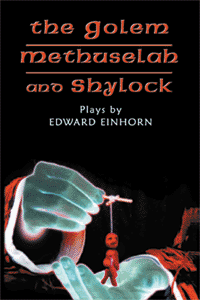
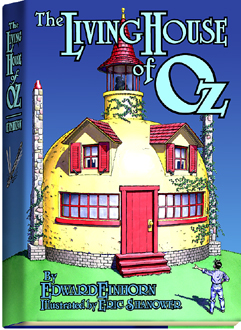
Spotlight on: Edward Einhorn, Writer/Playwright-Director by Andrew Angus Edward Einhorn is a playwright, novelist, director at the same time. He published his first playbook entitled, The Golem, Methuselah and Shylock in 2005. He also wrote and published a children's novel entitled, Paradox in Oz and a children's picturebook, The Living House of Oz. He has experienced directing TV-based plays in Great Britain. His first full-length playbook, The Golem, Methuselah and Shylock was released in 2005. His first published playbook consists of four plays, "The Golem", "The Living Methuselah", "A Shylock" and "One-eyed Moses and The Churning Red Sea".. I asked Ed what his plays are all about. Edward revealed: "I based GOLEM STORIES on the old Kabalistic legend of the golem, with my own twists. It's a ghost story and a love story, about a childlike clay man who may be a demon inside. THE LIVING METHUSELAH is about the oldest living man from the Bible (and the oldest living woman, Serach). It examines whether the will to survive is a virtue in itself. For A SHYLOCK, I made up a professor, Jacob Levy, who interrogates every character in The Merchant of Venice to find out what Shylock is really like. Everyone he meets gives him a different answer, reflecting the ways Merchant has been interpreted through the years. His guide is an interpretation of Hamlet--in this case, a woman." Ed was born in Elizabeth, New Jersey but now he lives in Manhattan, New York. He took writing as his college course. He was active in theater in college but not so much in high school. He was inspired to name his theater group called "Untitled Theater #61" while visiting an art gallery. Aside from theater, he also likes to dabble in photography. He started to write plays at the age of 17. He was editor-in-chief of the highschool newspaper. My interview with Edward is so far the longest interview I have made during the one year life of Muses Review. I asked him 70 questions! Well, the reason I asked him 70 questions is simply because I am also interested in theater. I decided to exhaust all the questions I can ask about his theater experiences. I believe many people out there and the readers of Muses Review wanted to know the intricacies of staging a play but have no time to know it. I thought I have to grab this opportunity to interview Edward exhaustively because published playwrights are hard to find in the internet. I asked Edward how did he start his theater group. Edward replied, "I started it just after college as way to do theater I was really excited about. It began as a way mostly to showcase my work, then changed to be an entity of its own...... For my first production, I was director, stage manager, lighting designer, set designer, sound designer, wardrobe and stagehand. My friend Mike was the Assistant. .....It takes a long, long time to build. Don't start unless you want to be at it for a while, and of course, like most art, you have to really love it to have it be worth the small amounts of money." Edward likes plays that are in the absurd genre. He was exposed to reading playbooks by his brother who read him a playbook by Eugene Ionesco and Samuel Beckett when he was 7 years old. I received Ed's playbook on October 2005. After reviewing his book for two months, I decided to make him the first "Featured Writer of the Month" for Muses Review. For the past one year, I only interviewed poets and made them "Featured Poet of the Month". This time, I am interviewing and featuring writers in Muses Review. Staging a play seems to be a very difficult activity. So, I asked an important question to Ed: What is the most difficult part in staging a play? Is it finding funds, finding an audience, finding actors, finding staff, etc. Edward revealed, " Funds are always hard. Hand in hand with that is reaching an audience with a limited marketing budget, and fighting for attention amidst the many, many show being produced." I always wondered how theater plays are financed. So, I asked Ed about this financing issue. I posed a question: Do you finance your own play or do you rely on donors or corporate sponsors, government grants? To this question, Ed answered, "My theater company depends on donors, grants and box office. I helped finance the first couple of shows, many years ago, but since then one of my main tasks has been fund raising. When we are lucky we get a sponsor, but that's rare." Interviewing Ed is an enlightening and an educational experience. I learned many issues and lessons about theater. I also began to understand the plays in his book from his answers. If you want to see the schedule of Edward's plays, just visit his website at www.untitledtheater.com. If you want to learn more about his theater experiences and his books, I suggest you read my interview entitled, "Edward Einhorn: Modern Theater of the Absurd". The title of the interview was suggested by Edward himself which I gladly approved. (End of feature.) Copyright 2006 by Muses Review. All rights reserved. |
 |
| The long interview is cut short. The whole interview will be published in the printed edition of Muses Review. |
|
| Edward Einhorn's playbook and picture book. |
|
| Edward Einhorn Writer from New York |
| Interview is Copyright 2006 by Muses Review. All rights reserved. |