| Muses Review - Book Review- Summer 2005 |
| Charles P. Ries's Book Review |
| Buy This Book: Last Call: The Legacy of Charles Bukowski Edited by: RD Armstrong |
| Charles P. Ries's Book Review is published in Muses Review with permission from the author. |
| To: "MUSES REVIEW" Subject: REVIEW / LAST CALL: THE LEGACY OF CHARLES BUKOWSKI - CHARLES P. RIES Date Received: Tue, 1 Mar 2005 19:15:45 -0600 ------------------------------------------------------ Title: Last Call: The Legacy of Charles Bukowski Edited: by RD Armstrong Pages: 124 pages / Price: $15.99 Publisher: LUMMOX Press (www.lummoxpress.com) PO Box 5301 San Pedro, CA 90733 ISBN 1-929878-06-0 ---------------------------------------------- Review By: Charles P. Ries Word Count = 1,027 Prior to reading Last Call: The Legacy of Charles Bukowski I knew very little about Charles Bukowski other then what I'd gleaned from watching Francis Ford Copolla's 1987 film, Bar Fly. And from a night twenty years ago, when I shared a hotel room with a woman I'd met and she read some of Bukowski's poetry. I recall how amazed I was by his frank vulgarity and intelligence. While I know there are plenty of other poets of his generation using vulgarity, he did it with unique talent and application. What I remember most from that first reading was that he had the remarkable ability to find humor in the snake pit. Indeed, in Frank S. Palmisano's essay in Last Call titled, GRAUSTARK: Reflections on Charles Bukowski, he says, "What I remember most vividly about my encounters with Charles Bukowski was his ability to make me laugh. And not just those internal smiles that one can keep down in the pit of his stomach, but a gut-busting chortle from the deepest recesses of the soul." Refined, academic poetry is seldom funny. Less refined street poetry is sometimes funny, but not necessarily clever. Bukowski however, both drunk and sober, seemed to be born with the devil in one hand and the coyote/trickster in the other. And this, coupled with his innate intelligence, compulsive writing and willingness to confess, made Bukowski great. LAST CALL is presented in three sections: Poetry, Fiction and Essays. Since I knew so little about Bukowski going in, I choose to read it from the end to the beginning. And indeed, I think this would have been a better way to structure the book. The nine featured essays are well written, insightful and relevant. In Todd Moore's essay titled, HUSTLING FOR DRINKS, PRAYING FOR LINES he says, "Charles Bukowski wasn't the only small press poet who will ultimately leave a powerful legacy. There are a few others, but maybe only one or two who have written as authentically or as much as Bukowski did. Bukowski was one of those natural forces that come along maybe once or twice in a generation. I can't think of any contemporary writer who was quite like him." Moore concludes with, "He was the least likely candidate of his generation to become an important American writer and yet he did just that. In spite of the snobs who despised him." And in Michael Basinski's essay titled, LIFE AND DEATH IN CHARLES BUKOWSKI'S LAST NIGHT OF EARTH POEMES , he says, "Writing was Charles Bukowski's salvation. Throughout his life his identity was anchored by the word. In the poem The Creative Act, Bukowski revealed that it was in fact his writing that was the sole purpose in life. He wrote, "for the 5th of July / for the fish in the tank / for the old man in room 9 / for the cat on the fence // for yourself." And in the poem Death is Smoking My Cigars, he wrote, "I just wanted to get the word / down; / fame, money, didn't matter." And again in the poem Only One Cervantes, Bukowski wrote, "writing has been my fountain / of youth / my whore, / my life / my gamble." After reading the essays I moved on to the first and second sections of LAST CALL and found a solid collection of fiction and poetry which was both inspired by and/or about Bukowski. I got a chance to see what metaphors this man stimulated in the minds of writers who adored him, and others who hardly knew him. Here again, I found that LAST CALL delivered with a wide and note worthy collection of work. I particularly liked Mark Terrill's poem Bukowski 3/10/94 where in the second stanza he says, "More than anyone else / he proved that poetry / didn't have to be an / academic thing, or / strictly for sissies / or phonetic windbags / that it was something/ that could be lived / and felt and understood/ as real as that cheap red wine/ as real as those bills/piled up in the mailbox/as real as the landlady / hounding you for the rent / as real as those shit jobs / and crazy fucked up women / as real as hangovers and / the blazing Los Angeles sun / as real as anything at all." Though I had never read a book about Bukowski prior to LAST CALL, I felt I got what I needed to begin to grasp who this crazy, brilliant, troubled poet was. But I believe even the true followers of his work will enjoy this tribute. It is filled with the work of 42 writers including: Alan Catlin, Gerald Locklin, Michael Lefanto, Bretton B. Homes and William Taylor, Jr. I asked RD Armstrong, why he took over two years to put this book together and edit it, he said, "Why did I do this? The better question is why am I the only one to do this? Buk has had such a profound effect on so many of us. I'm surprised that he hasn't had more homages published. I've always said that his work is what moved me to write again. And while I've enjoyed a limited success, I like to think that the very fact that I have a "voice" at all is because of knowing Buk and his style." No doubt about it, Charles Bukowski was a trip, a genius and a drunk. He climbed out of an abusive childhood, decades of poverty and alcoholism; numerous menial jobs and turbulent relationships; through 14 years as a postal employee; and eventually became an international celebrity. He was a drunken muse bashing and bending the poetry establishment. The little man who just kept pounding and pounding and pounding until, one day, the wall came down. While alive, and now dead, he reached the height of what only a very few poets ever attain - he became a metaphor. _________________ Charles P. Ries lives in Milwaukee, Wisconsin. His narrative poems, short stories and poetry reviews have appeared in over ninety print and electronic publications including: Circle Magazine, Wisconsin Review, Rockford Review, Free Verse, and Clark Street Review. He has received three Pushcart Prize nominations for his writing and most recently read his poetry on National Public Radio?s Theme and Variations, a program that is broadcast over seventy NPR affiliates. He is the author of THE FATHERS WE FIND, a novel based on memory from which excerpts have appeared in MusesKiss, Write On!/Just Stories, Iconoclast, Free Verse, Toasted Cheese Literary Journal, Romantics Quarterly, SNReview, Thunder Sandwich and The Wisconsin River Valley Review. Ries is also the author of three books of poetry ? the most recent titled, Odd which was published by Pudding House Publications in Columbus, Ohio. His forth book of poetry; The Last Time will be published by Dark Side of the Moon Press in Tucson, Arizona and is slated for release in 2005. He is on the board of the Woodland Pattern Bookstore in Milwaukee, Wisconsin. You may find additional samples of his work by going to: http://www.literati.net/Ries/ and you may write him at his email charlesr@execpc.com ---------------------------------4 |
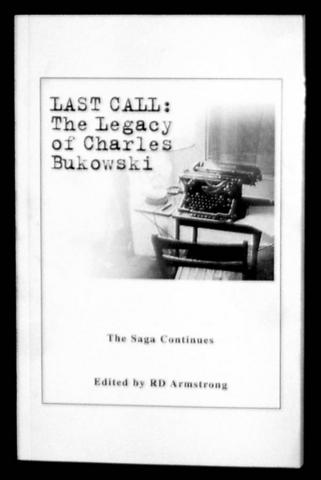 |
| Book Data: Title of Book: Last Call: The Legacy of Charles Bukowski Editor: Raindog Armstrong (California) Genre: Anthology of Poetry, Short Story and Essays from different poets/writers. ISBN:1-929878-06-0 Publisher: Lummox Press (California) www.lummoxpress.com Release Date: 2004 Book Format: Paper back Book Binding: Perfect Book Size: 5 in x 8 in Pages:124 Price: $16.00 Shipping: 4$ for first book.(3$ for second piece.) Bookstores: Muses Review Method of Payment: Credit Card or check Email: editor@musesreview.org Postmail: 2267 Woodranch Road, San Jose CA 95131, USA Book Award: 1st Muses Prize - Best Poem Anthology of Year 2004. |
